
Valencia Parole and Probation Paths
Parole and probation can both place a person in the community under rules, yet they start at different points. Parole follows confinement in a New Mexico Corrections Department prison. The New Mexico Parole Board grants, denies, or revokes parole where Board action is required, while NMCD Probation and Parole manages day-to-day community supervision. Probation is part of a court judgment. A judge may order it after confinement or instead of prison. In both cases, the supervising officer and court or Board documents are stronger evidence than a name match alone.
Valencia County Pretrial Services is a third route. It monitors a person whom a judge released while the case remains unresolved. Conditions may include in-person reports, GPS, testing, Soberlink, or counseling. That person has not been placed on parole merely because release came with rules.
The distinction changes which record should be requested. A court judgment establishes probation. A parole order or NMCD release form establishes the prison-to-parole path. A pretrial release order explains supervision before disposition. The NMCD Release Checklist reinforces the difference by listing Parole, Discharge, and Discharge to Probation as separate release routes. Use the document that created the status, then use the supervising office to check whether it remains active.
| Status | How it begins | Best verification path |
|---|---|---|
| Parole | Follows an NMCD prison term under a parole decision or statutory release framework | NMCD Active search, parole order, and the assigned P&P office |
| Probation | Comes from a court judgment, with or without prior confinement | NMCD Active search, court judgment, and the assigned P&P office |
| Pretrial supervision | Comes from a release order while charges remain pending | Court docket or order and Valencia County Pretrial Services |
| Discharge | Ends a sentence or a term of supervision | Final order, certificate of discharge, or an inactive NMCD record |
- Parole
- Supervised community release after a prison term.
- Probation
- Court-ordered supervision that may replace or follow confinement.
- Absconder
- A person alleged to have stopped reporting or complying with supervision.
- Discharge
- The formal end of custody or supervision obligations for that sentence.
Verify Valencia Post-Release Supervision
The NMCD offender search is the public starting point for parole and probation in Valencia County. It covers people incarcerated by NMCD and those supervised by NMCD Probation and Parole. It does not cover a person held only at the Valencia County Detention Center. Search status matters. Active can include a person in prison or in the community, Include Inactive can surface a completed state case, and Absconder Only narrows the search to alleged supervision absconders.
- Gather the full legal name, approximate age, and NMCD offender number if known. Similar names are common.
- Open the NMCD search and enter a last name, first name, or offender number. Complete the CAPTCHA.
- Start with Active. Use Region II as a useful filter, but do not assume every Valencia County resident is supervised there.
- Run Include Inactive if the person may have completed supervision or discharged from NMCD.
- Use Absconder Only when that status is the issue. Treat the result as an allegation that needs office confirmation.
- Call the assigned P&P office with the legal name and offender number. Ask whether the record reflects prison custody, parole, probation, absconder status, or discharge.
Adult Prison Division data updates nightly, and NMCD asks users to allow time for changes. Probation and Parole data is described as real time, but NMCD still directs users to verify legal status with the office. For a county-jail release that has no state-prison or NMCD supervision link, use the custody and records paths on the Valencia County released inmates search.
The official NMCD search screen shows the available identity and status filters:
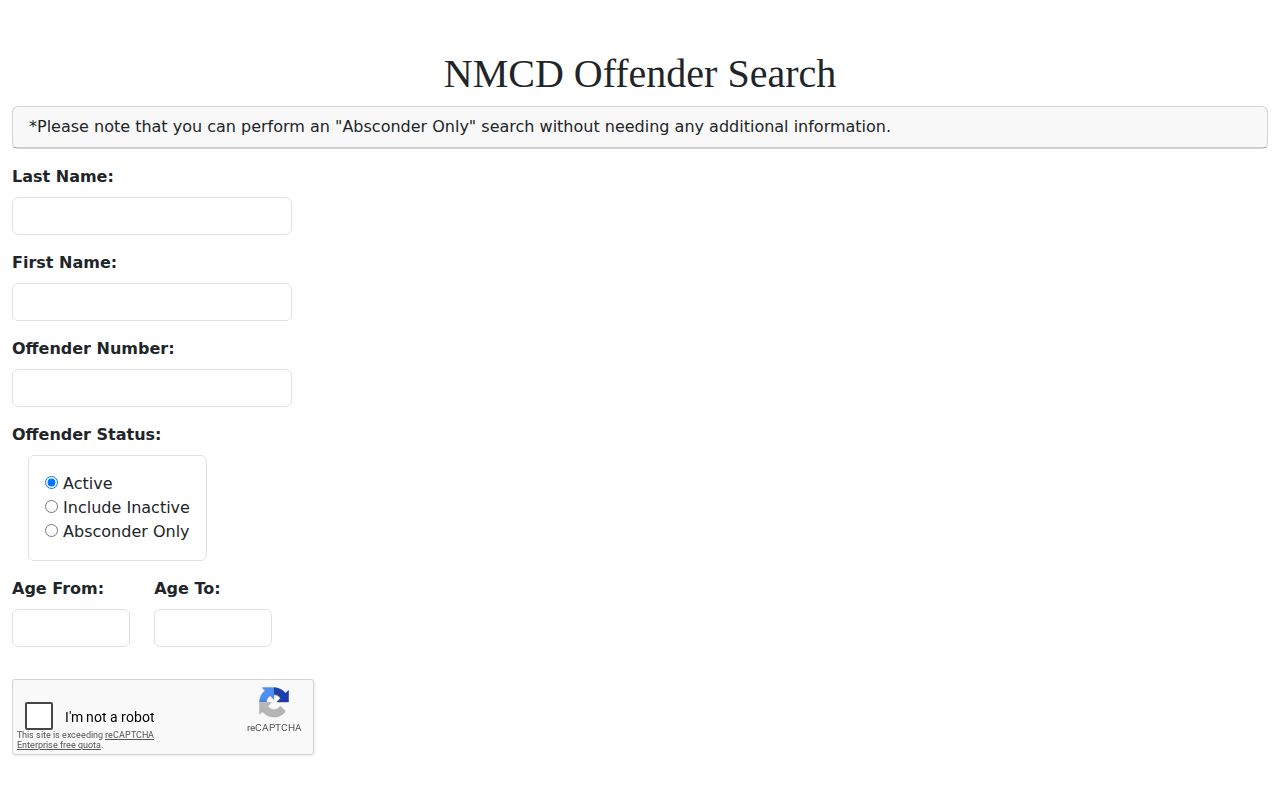
Those status choices make the search useful for both active supervision and completed NMCD cases, but a result still needs identity and office confirmation.
Valencia County Supervision Office
Valencia County is in NMCD Region II, which covers the Second and Thirteenth Judicial Districts. The local community contact is Los Lunas District Office 13A. It is the right office to verify whether a released person is assigned to Valencia County supervision and to clarify an Active or Absconder result. No office hours were supplied in the official research, so call before visiting.
Los Lunas District Office 13AAttn: Probation and Parole
3201 Highway 314 SW
Los Lunas, NM 87031
Office: 505-220-6481
Supervisor: Connie Bouyer
Cell: 505-934-3160
Give the office enough detail to separate people with similar names. The full name and offender number are best. Ask a narrow status question, such as whether the person is assigned to District 13A and whether supervision remains active. Staff may limit what can be disclosed, and an online record is not authority to demand private case information.
Valencia Parole Office Handoff
Valencia County has an unusually clear before-and-after release structure. The NMCD Region II directory lists a separate institutional P&P officer at Central New Mexico Correctional Facility and the Los Lunas community office. Before release from CNMCF, the institutional officer helps with parole planning. After release into Valencia County supervision, District Office 13A becomes the local verification point.
CNMCF Institutional Probation and Parole1525 Morris Road / PO Drawer 1328
Los Lunas, NM 87031
Office: 505-383-2955
Officer: Crystal Shoemaker
Cell: 505-934-6999
This handoff also explains why the county jail lookup is the wrong tool for a CNMCF release. CNMCF is a state prison. Its institutional planning, NMCD offender record, parole paperwork, and District 13A assignment form the correct chain.
Note: Institutional P&P handles planning before release; District Office 13A handles Valencia County community supervision after release.
Valencia Supervision and Absconders
Conditions depend on the court judgment, parole order, and approved plan. They can govern reporting, location, programs, or other conduct. A breach may lead to added review, a warrant, revocation proceedings, or a return to custody, but the precise result comes from the responsible authority. Parole revocation is within the New Mexico Parole Board’s powers under Section 31-21-25. Probation action belongs to the court process.
An Absconder Only match means NMCD alleges that the person stopped complying with supervision. It does not prove the person is now jailed. It also does not erase the earlier release. Confirm the identity and current legal status with District Office 13A. If a fresh custody event is the concern, VINE may provide an alert for a participating jail or prison, but it is not a supervision-history database.
Valencia Parole Hearing Records
The New Mexico Parole Board holds individual hearings weekly at correctional institutions and reports roughly 300 hearings per month. Those hearings are closed. The public quarterly meeting notice and archive concern Board governance, not a calendar for a named person. No official public person-level hearing calendar or searchable decision database was found.
Section 31-21-25 requires records of Board acts, decisions, and orders, as well as written reasons to the prisoner or parolee after denial or revocation. A person seeking an existing order can make a focused request to the Board Records Manager. Disclosure and redaction still depend on law.
New Mexico Parole Board4337 State Road 14
Santa Fe, NM 87508
505-827-8853
nmapb.paroleboard@apb.nm.gov
The official Board page documents the hearing cadence and closed-hearing rule:
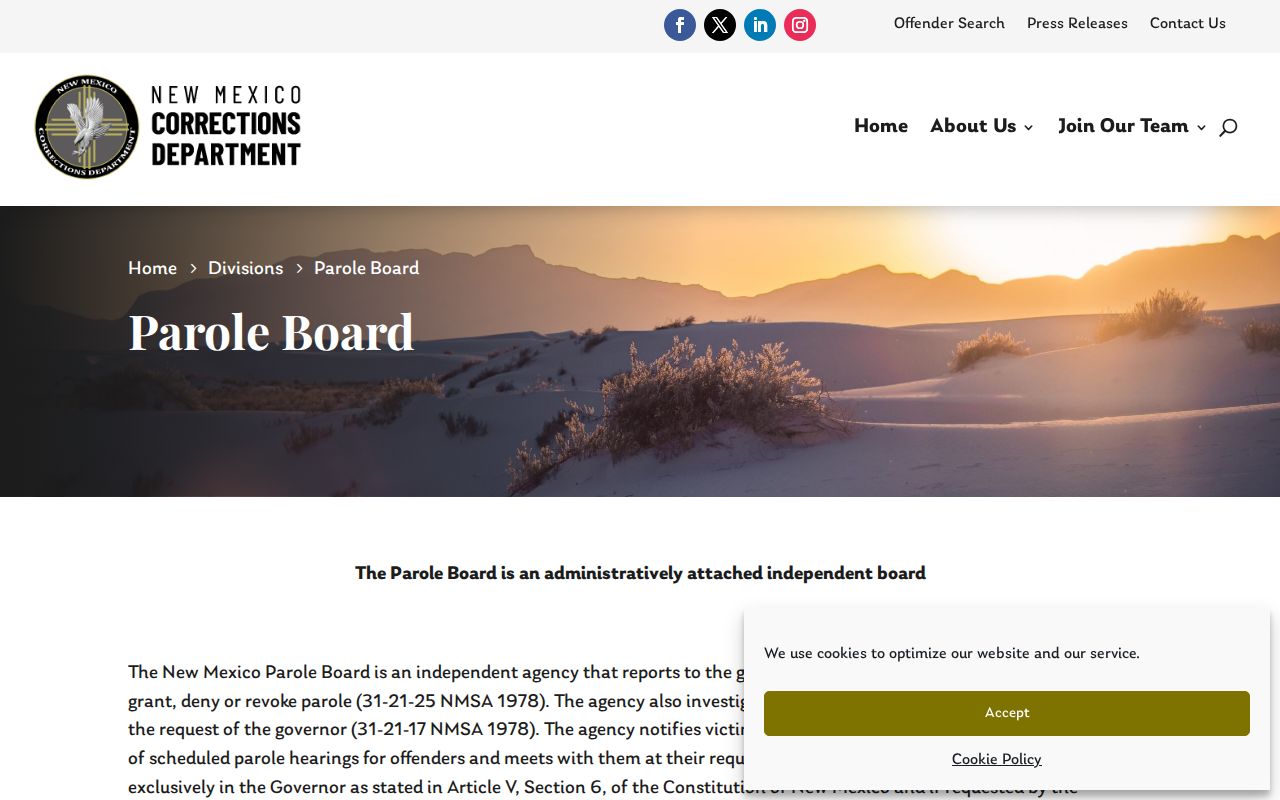
The Board page is a source for process and contacts, while a particular grant, denial, revocation, or final discharge must come from the person’s record.
Valencia Release Reentry Support
The VCDC mission expressly includes diversion assessment, transition and discharge planning, and an individualized discharge program. A county Reentry Specialist description adds case management, health and behavioral-health referrals, family reintegration, immediate crisis support after release, and links to medication-assisted treatment. These services support continuity of care. They do not establish parole, probation, or a release date.
That distinction matters in Valencia County. A person leaving VCDC may receive discharge planning without being on NMCD supervision. Conversely, someone released from CNMCF may report to District Office 13A even if no county-jail record exists. Use the service contact for help with transition needs and the supervising office for legal-status verification.
Valencia Supervision Discharge Records
Supervision ends through formal action, not merely because a person disappears from a search. NMCD’s Release Checklist distinguishes Parole, Discharge, and Discharge to Probation. Successful parole completion leads to a final order and certificate of discharge. A probation term ends under the court judgment and later court record. An approved parole plan can also affect when physical community release occurs.
For a completed NMCD case, search Include Inactive and request the existing discharge document if proof is needed. New Mexico IPRA permits a written request that describes the record with reasonable detail, but an agency need not create a new report. The Board, court clerk, or NMCD custodian may redact protected material. A final document is more reliable than inferring discharge from an absent name or stale screen.
Written requests gain force when they identify a specific existing item. For parole, that may be a final order, certificate of discharge, decision, or revocation order. For probation, it may be the judgment and sentence or a later court order. New Mexico law allows oral or written inspection requests, but the statutory enforcement process attaches to a written request. Ask for electronic production when the record exists electronically and expect protected parts to be redacted rather than assuming the whole record must be withheld.
Note: A search disappearance can reflect a data change or outage; it does not prove that Valencia County supervision ended.