
Valencia Projected Versus Actual Release
The New Mexico Corrections Department uses the term Projected Release Date, often shortened to PRD. Its official Release Checklist includes that field and separately identifies Parole, Discharge, and Discharge to Probation. A PRD is a working calculation used while staff prepare a state-prison release. It is not an unconditional promise that a person will leave custody on that day.
An actual release date records what occurred. The person may have discharged, begun parole or probation, or moved to another custodian. A transfer is not a community release. For someone at Valencia County Detention Center, there may be no calculated date at all. Pretrial custody can turn on court action, bond, other holds, or transfer. Even a short county sentence must be confirmed through VCDC and the court rather than calculated with state-prison credit rules.
Find a Valencia Projected Release Date
Start with the likely custodian. NMCD’s offender search covers state prisoners and people on state probation or parole. It expressly does not cover county or city detention centers. The live public result could not be fully audited because it requires a CAPTCHA, so do not assume every profile displays PRD. The official NMCD records policy proves that PRD exists as a department record field.
- Confirm the full name, approximate age, booking or offender number, and likely facility.
- For an NMCD prisoner, open the NMCD offender search. Search by name or offender number and compare identity details.
- Use Active for a person in NMCD custody or on supervision. Use Include Inactive for a former state prisoner.
- For a pending state-prison PRD, contact the Classification Officer at the current prison. NMCD says central and records offices do not provide release-status updates.
- For VCDC, ask Records about the existing expected-date or custody record and check the court docket for release, bond, sentence, or hold orders.
- Near the date, use an actual-release notification and request the completed release entry if firm proof is needed.
The NMCD public search form documents its name, offender-number, status, region, and age filters:
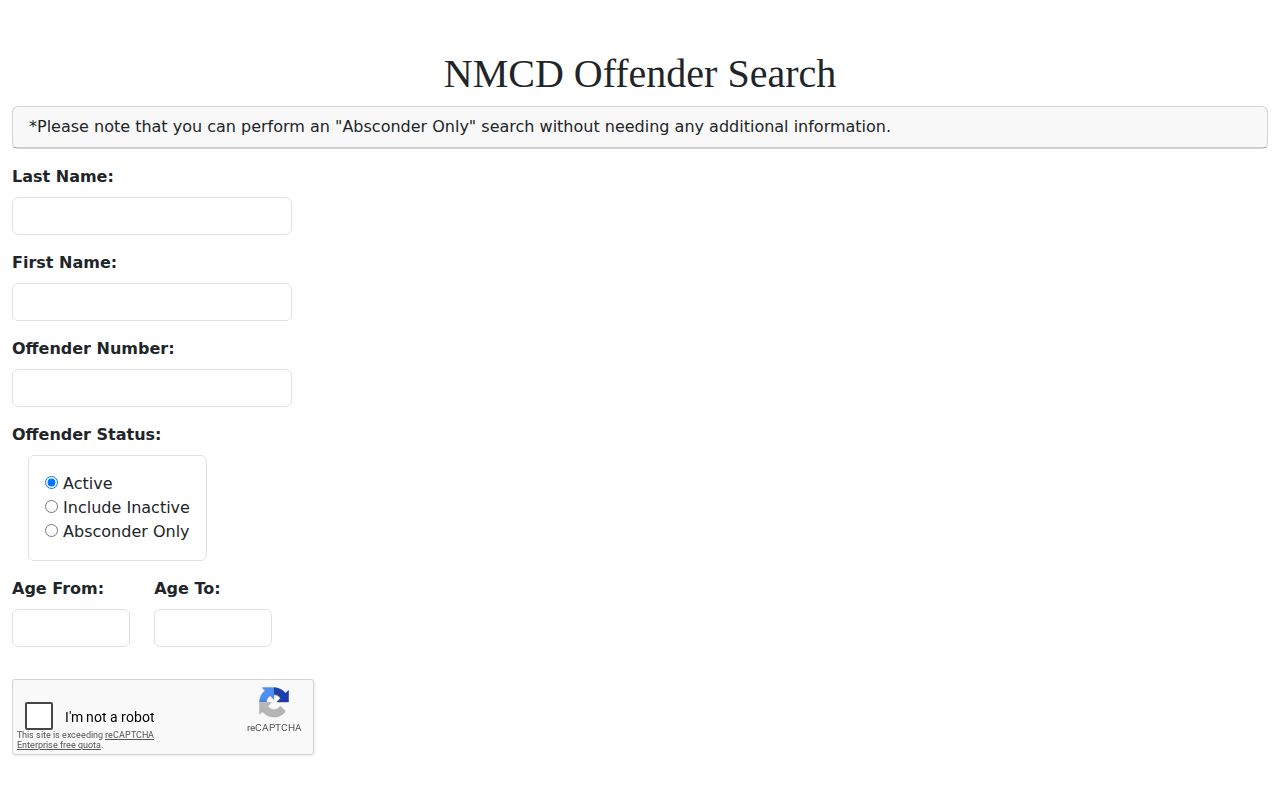
The status filters help locate a state record, but they do not convert the search into a Valencia County jail locator or guarantee that the current result shows PRD.
For a full county-jail record path, the Valencia County released inmates lookup explains how to combine VINE, the court case, and a focused county records request.
Valencia NMCD Earned Release Credit
NMCD calls its good-time framework earned meritorious deductions, or EMD. The current policy was revised in March 2026 and applies to eligible NMCD inmates for covered crimes committed on or after July 1, 1999, including qualifying people still incarcerated when the 2025 changes took effect. Life sentences are excluded. Section 33-2-34 supplies the current statutory basis, with Sections 33-2-36 and 33-2-37 addressing related administration, forfeiture, and restoration.
After presentence-confinement credit, the maximum monthly EMD is four days for a serious violent offense and 30 days for an offense not designated serious violent. A person in the serious-violent category earns no EMD during the first 60 days. Active participation in approved programming is required. A parole violator keeps the credit category tied to the underlying offense.
Calling the rule an “85% law” is too broad. Four credit days in a 30-day month implies about 86.7 percent served before other mechanics, but the statute states a credit rate rather than a universal percentage promise. Sentence structure, presentence credit, offense class, discipline, holds, and parole planning all affect the working date. State-prison arithmetic should never be applied to a VCDC pretrial detainee.
The 2025 amendment changed how qualifying deductions are awarded beginning July 1, 2025. Credit already earned, unearned, forfeited, or restored under the prior method vested and was not recalculated away. That transition is one more reason not to estimate a date from sentence length alone. The individual’s official calculation must account for the offense date, category, presentence confinement, and existing credit history.
Note: PRD is an NMCD records term; it is not proof that every public offender-search profile currently displays the field.
Valencia Release Credit Awards
Section 33-2-34 also permits qualifying lump-sum EMD awards. The current framework lists 30 days for an approved vocational, substance-use, or mental-health program; 90 days for a high-school-equivalency credential or specified disability exception; 120 days for an associate degree; and 150 days for a bachelor’s or graduate qualification. Extraordinary or heroic conduct may also support discretionary credit.
Lump sums can supplement monthly deductions, but each award and the total within a consecutive 12-month period are capped at one year. Life and life-without-parole sentences are not eligible. Credit may be revoked or forfeited for nonparticipation, a guilty disciplinary finding followed by restrictive custody, or refusal of required labor. Some credit can later be restored. A lockdown interruption ordinarily does not cause revocation unless the person contributed to it.
These rules explain why two people with similar sentence lengths can have different PRDs. The reliable source is the individual EMD statement or record calculation, not informal arithmetic. On request, that statement may detail awards, revocations, forfeitures, restorations, corrections, and the current balance.
Program completion also does not mean credit appears instantly. The award must qualify, be documented, and be entered by authorized staff. If a date seems to move after a program or disciplinary event, ask for the current statement and any Change of Projected Release Date notice. Those records explain the computation without asking a public search screen to do more than it was built to do.
Why Valencia Release Dates Change
NMCD policy includes a Change of Projected Release Date form and written notice because the date can move in either direction. Only authorized records staff update the offender-management system. The person’s actual calculation, court orders, and custody obligations control.
| Factor | Possible effect on release |
|---|---|
| Presentence confinement credit | Changes the amount of time remaining at the start |
| Monthly EMD category | Serious violent and other offenses earn at different maximum rates |
| Program or education award | A qualifying lump sum may move PRD earlier |
| Discipline or nonparticipation | Forfeiture or revocation may move PRD later |
| Restoration or correction | Restored credit or a corrected record may move PRD earlier |
| Amended court order | Changes the sentence or lawful credit |
| Concurrent or consecutive terms | Changes the aggregate sentence calculation |
| Detainer or other custody | May block community release even when the NMCD term reaches an event |
| Parole plan or decision | An unapproved plan, grant, or denial can alter the route and timing |
A detainer is a request or hold from another authority. It can mean the person leaves NMCD but enters another custodian rather than the community. Likewise, a parole eligibility date merely marks when the Board may consider release. It is not the PRD and does not guarantee release.
A court amendment can be just as important as a credit entry. Concurrent terms run together, while consecutive terms are served one after another, which changes the aggregate end point. Records errors can also be corrected. When dates conflict, compare the most recent court order, NMCD calculation notice, and facility record rather than choosing the earliest date.
Valencia Parole Date Boundaries
For ordinary determinate sentences, the Parole Board states that parole after the prison term is generally mandatory for post-1979 sentences, subject to older-sentence and first-degree-murder rules. Section 31-21-10 generally assigns two years of parole for first- through third-degree felonies and one year for fourth-degree felonies, with special provisions for some offenses. An approved parole plan is required. A missing or refused plan may keep the person confined while the parole term runs.
Life-sentence eligibility follows another framework. Section 31-21-10 generally sets consideration after 30 years, subject to the youth provision, and a denial leads to a later hearing. Section 31-21-10.2 sets 15-, 20-, or 25-year eligibility points for qualifying offenses committed as a child. Life without release or parole is ineligible. Those points are hearing eligibility rules, not automatic physical release dates.
Valencia County Expected-Date Records
A March 2026 county health agreement says VCDC already exchanges timely booked and released files and will add expected-release-date information to its interface. This is a distinctive local fact: Valencia County maintains operational date data even though it does not publish a public 24-hour or 72-hour release feed. The health interface itself is not public.
The agreement supports a precise Inspection of Public Records Act request for an existing expected-date or release entry. It does not guarantee that every field is retained or open. Identify the person, booking number or date range, and the exact existing field sought. Ask whether the date was expected or actual and whether the event was community release or transfer. Under IPRA, the county need not create a new calculation or report.
A written IPRA request can ask for electronic production of an existing record. New Mexico law expects inspection as soon as practical and generally no later than 15 calendar days, with a written timing response when records are not available within three business days. That schedule is a records-access rule, not a way to obtain real-time release confirmation. Urgent custody questions still belong with VCDC and the court.
Confirm Valencia County Release Dates
Near a projected date, use the current facility’s correct channel. For CNMCF or another NMCD prison, family members seeking a pending PRD are directed to the Classification Officer. NMCD’s Central Office, Constituent Services, and Records Bureau state that they will not provide current release updates or statuses. For VCDC, Records and the court are the proper sources because NMCD has no jurisdiction over county detainees.
Register for an actual custody event through the Valencia County VINELink check, then confirm the notice with the responsible custodian. An NMCD inactive record, discharge certificate, parole paperwork, or completed jail release entry provides the retrospective trail. If another hold exists, check the receiving agency.
- Projected Release Date
- NMCD’s working date used in release planning.
- Earned meritorious deduction
- Eligible sentence credit earned under New Mexico law and policy.
- Detainer
- A hold or request from another authority that may lead to transfer.
- Actual release
- The recorded event showing what custody change occurred.
Note: Confirm close to the date because credit, court action, holds, parole planning, and record corrections can change the outcome.