
Where VCDC Releases Go
Valencia County Detention Center holds adult men and women awaiting court action as well as people serving county sentences. A community release can follow bond, a judge's order, time served, dismissal, or another lawful disposition. Valencia County Pretrial Services also supports judge-ordered non-monetary release. A participant may have to report, submit to testing, use GPS or Soberlink, attend counseling, or follow other court-set conditions. These are community-release routes, but they are not all the same legal outcome.
Departure from VCDC can also mean transfer. New Mexico Corrections Department custody follows a state commitment. A federal hold may send someone into a Bureau of Prisons or U.S. Marshals path, while an immigration handoff is checked through ICE. Another jail may receive the person on a warrant or detainer. A detainer is a request by another authority to keep or transfer a person when the first custody ends. Ask whether the event was release to the community or transfer, and request the destination when it is recorded and may lawfully be disclosed.
A person missing from the VCDC lookup may have been released, transferred, or affected by a data issue. The disappearance alone is not proof.
Confirm a VCDC Release
The county's current detainee-information page sends named-person searches to VINELink. It does not publish a verified rolling archive of everyone released during the past day or three days. VINE can signal that custody changed, but the message should be read closely. A transfer event is not a return to the community, and a delayed alert should not replace direct confirmation when timing matters.
Use a short chain that matches the question. Gather the full legal name, an approximate age or date of birth, a booking or case number when known, and an approximate custody range. Compare identifiers at every stage because common names can point to the wrong person.
- Search the named person through VINELink from the county's official detainee page and note the precise event and custodian.
- Check New Mexico Courts Case Lookup for a bond order, dismissal, sentence, commitment, or other docket event that explains the authority.
- Call VCDC Records and ask whether the person left for the community or another agency. Request the existing release entry when documentary proof is needed.
- Follow a transfer through the receiving system: NMCD, BOP, ICE, or the other county. Do not continue treating VCDC as the present custodian.
The court docket explains legal authority, not the minute of physical departure. Likewise, VINE is a notification service, not a certified county record. The strongest Valencia County Detention Center release confirmation pairs the VINE event with an actual VCDC custody or release entry and, where relevant, the court order.
VCDC Records and Contacts
Valencia County publishes separate extensions for the front desk, Records, and Inmate Case Management. Records is the direct route for an existing booking or release entry. The front desk handles general current-custody questions, while case management has a different operational role. Staff may disclose current charges and related bond amounts, but the county says housing, classification, medical, and mental-health details are not public detainee information.
436 Courthouse Road
Los Lunas, NM 87031
Main: 505-565-8900
Records: extension 1
Inmate Case Management: extension 3
Front desk: extension 4
The official detention staff directory lists the current contact channels. Its Records and Booking view is shown below. The directory should be checked before relying on an email address because personnel and routing details can change.
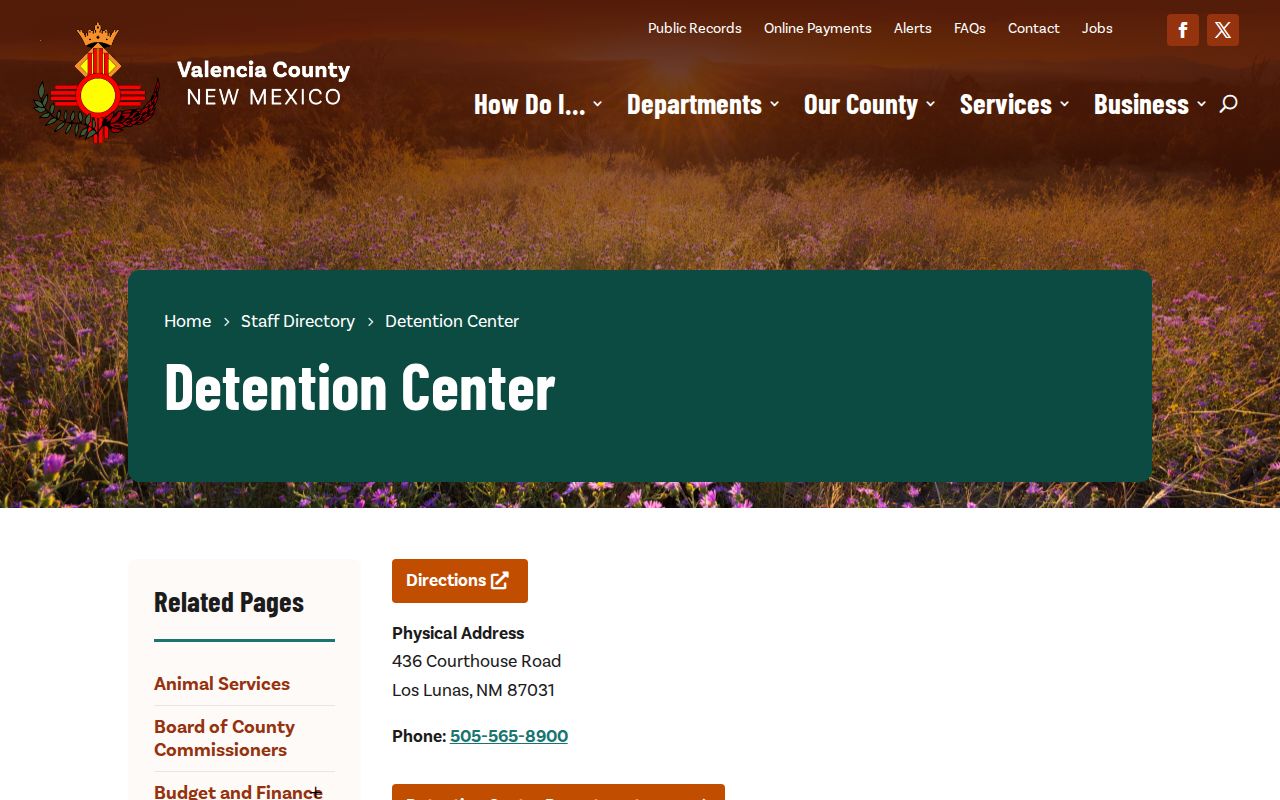
The published extensions help route a release question to the unit that holds the underlying Valencia County detention record rather than to a general search page.
Request Valencia Release Records
When an online check is not enough, use the county's NextRequest public-record portal. New Mexico's Inspection of Public Records Act, commonly called IPRA, favors requests that identify an existing record. The custodian is not required to create a new 24-hour list or answer a broad research question. Describe the record by person, date range, booking or case number, and facility.
A focused request can ask for the booking sheet, custody movement history, actual release date and time, release disposition, release authority or order, and a transfer destination if it was recorded and may be disclosed. Ask for an electronic copy when that format works. Booking photographs may also be requested, but their existence does not guarantee public disclosure. Redaction, expungement, juvenile confidentiality, privacy limits, and current retention rules may affect the response.
| Requested field | Why it matters |
|---|---|
| Actual release date and time | Documents physical departure from VCDC |
| Release disposition | Separates bond, time served, dismissal, or another outcome |
| Release authority | Connects the event to a court order or lawful basis |
| Custody movement | May distinguish community release from transfer |
| Booking number | Helps match the correct Valencia County episode |
IPRA generally requires inspection to be available promptly and no later than 15 calendar days unless the request is unusually burdensome or broad. Paper copying may carry statutory charges, while the research supports requesting an electronic existing record. No current official retention schedule was located that safely promises how long VCDC publishes or keeps a specific released-person record. Ask the county records custodian which current schedule controls.
Sections 14-2-1 through 14-2-12 contain New Mexico's IPRA rules. A request can be oral or written, but the law's enforcement process attaches to a written request. The written version should provide the requester's name, address, and telephone number and describe the record with reasonable particularity. No reason for inspecting the record is required. If the record cannot be produced within three business days, the custodian must send a written response addressing timing. Section 14-2-9 calls for exempt details to be separated or redacted while nonexempt material is produced.
Inspection itself is free. For paper no larger than 11 by 17 inches, a reasonable copying charge is capped at one dollar per page. An agency may require advance payment and recover allowed medium or transmission costs. When VCDC already holds the record electronically, asking for the native electronic format avoids needless paper and is supported by the statute's electronic-production terms. A denial should identify the law that controls the withheld portion rather than treating every law-enforcement record as automatically closed.
The New Mexico court route serves a different purpose. Case Lookup gives docket and case information, not the official document. Ask the correct district, magistrate, or municipal clerk for the existing release order, dismissal, judgment, or sentence when the legal authority matters. A certified order proves what the court directed. VCDC's movement entry proves that staff carried out the release or transfer. Keeping those functions separate prevents a court date from being mistaken for the actual exit time.
Inside Valencia County Detention
Valencia County operates VCDC as an adult county detention center. The county's 2022 comprehensive plan reports 160 beds and describes a population of pretrial detainees plus people serving county sentences no longer than 364 days. Warden Randy Gutierrez is identified in the current facility material. Those facts place the site in the county-court and short-sentence system. It is not a New Mexico state prison, and the NMCD search does not cover ordinary county detainees.
The official VCDC page describes diversion screening, transition and discharge planning, and programs tailored to reintegration. These services can support continuity after release, but they do not reveal a person's custody status. The official facility identity and mission appear in the captured county page below.
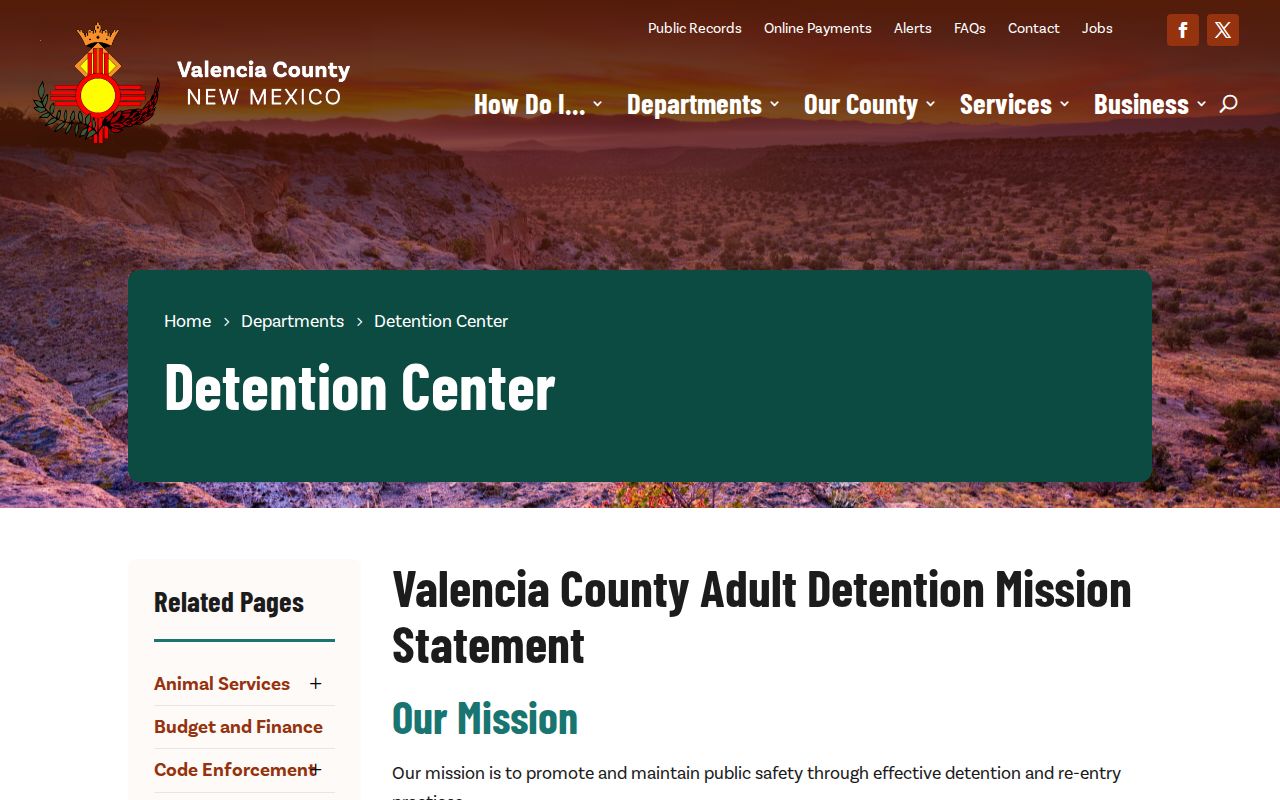
The facility's release-oriented mission explains why discharge planning may occur before departure, while VINE and the actual release record remain the tools for confirming the event.
Who Operates VCDC Today
VCDC opened in 2000. A county plan reports that Cornell Corporation managed the center through December 31, 2004. Valencia County assumed management on January 1, 2005, with 53 county employees and 160 beds. That history matters because old directories and commercial pages can preserve a former operator long after a transition. Current release and booking requests belong with Valencia County, not the past private manager.
A 2022 local report discussed a proposed 92-bed expansion using prefabricated cells. The source documents a proposal, not a completed expansion. Until a current official source confirms construction and operating capacity, the proposal should not be treated as present fact. The same date discipline applies to old bond instructions. A legacy county page mentioned money-order payment, a general magistrate cash-surety amount, and ankle-monitor timing, but payment methods and release procedures should be confirmed with Records before anyone relies on them.
Historical operating facts can identify the correct records custodian. They cannot prove a present release. For the event itself, return to VINE, VCDC Records, the county IPRA portal, and the court order.